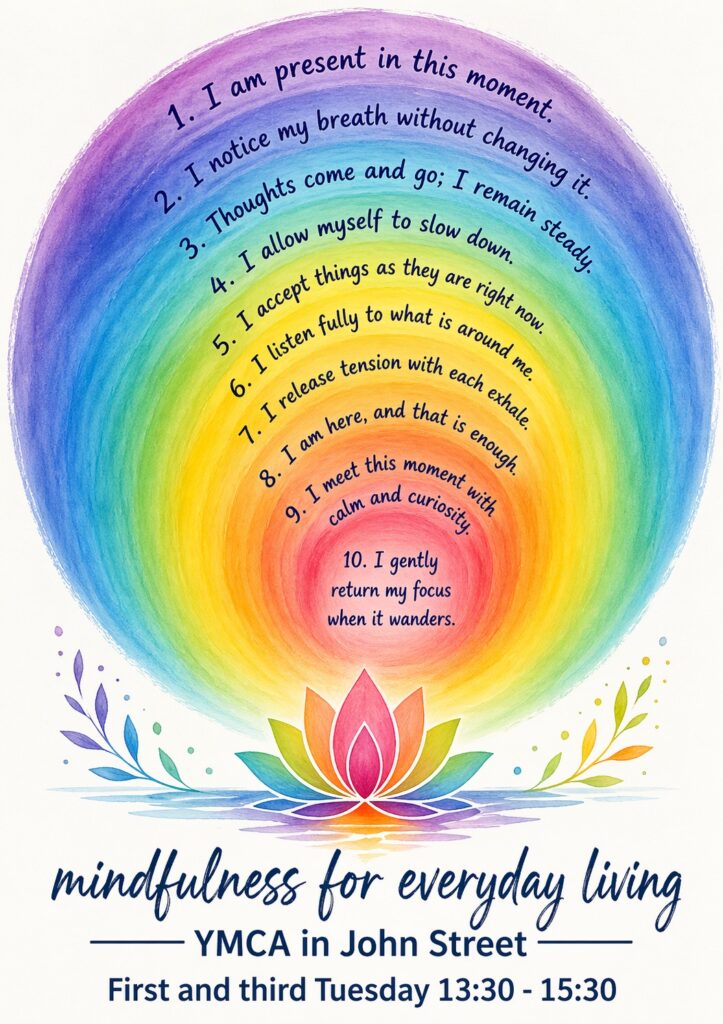

| Status: | Active, open to new members |
| Leader: | |
| When: | On Tuesday afternoons 1:30 pm-3:30 pm Weeks 1 & 3 |
| Venue: | Porthcawl YMCA |
Links to discussion papers
Creating the Life You Want,
One Mindful Moment at a Time
Most of us spend a surprising amount of time living on autopilot. We rush from one task to the next, replay old conversations, worry about future ones, and occasionally wonder where the week went. Mindfulness offers a simple alternative: waking up to the life that's happening right now.
One of the greatest gifts of mindfulness is learning to make your mind your best friend rather than your worst enemy. We all have an inner commentator, but sometimes it behaves more like a grumpy critic than a supportive companion. Mindfulness helps us notice those thoughts without automatically believing them. Instead of being pushed around by every worry or self-doubt, we can respond with a little more kindness and perspective.
A second aspect is reconnecting with our values. It's easy to drift through life following expectations, trends, or other people's ideas of success. Mindfulness encourages us to pause and ask, "What really matters to me?" When we know our values—whether that's family, creativity, community, adventure, or compassion—they can become a reliable compass for daily decisions.
Finally, the informal practice of everyday mindfulness invites us to pay attention. Not in a serious, mountain-top-guru kind of way, but in the simple moments: noticing the taste of your morning tea, listening fully to a friend, or appreciating a sunset instead of photographing it. Life becomes richer when we actually show up for it.
Mindfulness isn't about becoming a different person. It's about becoming more present for the life you already have—and perhaps discovering that the life you want begins with paying attention to this one.
If you haven’t attended before, please wear comfortable, unrestrictive clothing and bring a wrap if you think you might get cold.
Upcoming Meetings details
20th October
3rd November
17th November
1st December
For the first three months of 2027, we will be meeting once a month as follows:
5th January
2nd February
2nd March
No need to ring beforehand, just turn up. Everyone is welcome, the group format is a 15 min meditation to settle our minds , followed by a discussion on a theme, idea or arising issues, followed by coffee, tea and a chat and ending with a meditation.
Mindful moments
The Stories Behind October – from our youth to our golden years.
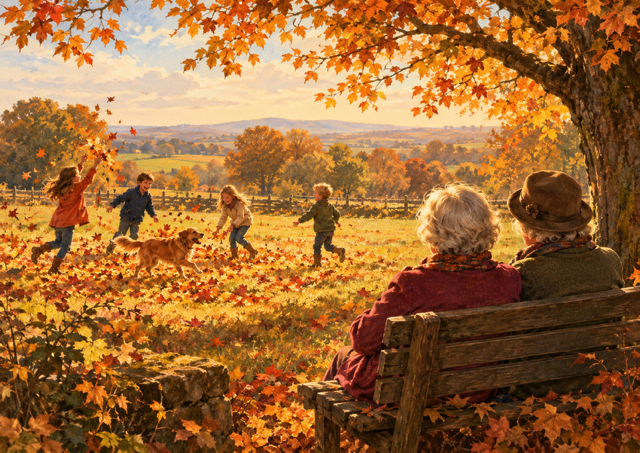
October has always seemed to me to be a month of change. The leaves turn gold and copper, the mornings become cooler, and the evenings draw in. But October has changed in other ways too. For those of us in our golden years, it can be a month filled with memories of traditions that were once simply part of everyday life.
The name October comes from the Latin octo, meaning eight. In the old Roman calendar, it was the eighth month of the year. Today, of course, it is the tenth, but the name remains—a small reminder that traditions can survive even when the world around them changes.
Think back to Octobers of our childhood. There were harvest festivals at school, conkers collected from beneath horse chestnut trees, piles of leaves to kick through and the excitement of knowing that winter was on its way. October was also the time to start thinking about Bonfire Night.
All the effort we used to put into our ‘Guy” scrounging bits and pieces for his body and clothing and collecting wood for our bonfire for weeks and weeks before, then hoping it wouldn’t rain when the big day came. Remember the jumping jacks🤣 how they used to chase poor unsuspecting people around, the joy of the bonfire, the fireworks, the smell of smoke in the cold air and if you were really lucky, a jacket potato cooked in the embers. Traditions have changed, it’s more about Halloween now, but the memories remain remarkably vivid.
And perhaps that is one of the interesting things about growing older. We have lived through enormous changes, yet the simplest memories can remain the strongest.
This is where mindfulness can quietly enter our autumn lives. Mindfulness doesn't have to mean sitting cross-legged in silence or following a complicated practice. It can simply mean being present for what is happening now.
Next time you walk through fallen leaves, listen to the sound beneath your feet. Notice the colours in the trees. Feel the coolness of the air on your face. Smell the woodsmoke or the damp earth after rain.
Instead of thinking only, “I remember when October used to be…”, perhaps ask yourself, “What is October giving me today?”
We can hold both things together: the memories of the past and an appreciation of the present.
Perhaps the greatest gift of our later years is that we have accumulated so many stories. A pocketful of conkers, a homemade Guy, a few pennies collected from neighbours, a harvest festival, a bonfire glowing against the November sky—these small memories form part of who we are.
But mindfulness reminds us that we don't have to live only in those memories. There are still new leaves to notice, new conversations to enjoy, new places to discover and new traditions to create.
So this October, perhaps we can celebrate both the October we remember and the October we are living now.
Take a moment. Look around. Listen. Breathe.
The seasons are changing, as they always have….
And so are we.
*** Our mindfulness group is a respectful, safe space for all our members,
but we are not therapists or a replacement for professional advice.
If you think you have mental health issues, please visit your GP. ***
All images used on the Mindfulness pages are either the Group Leader's photos or are AI generated.
Full list of Groups
Groups listed alphabetically
-
Astronomy
Status: Active
On Thursday afternoons
Weeks 1 & 3 at 2 p.m. -
Beach Clean
Status: Active
On Tuesday mornings 10:00 am
Weeks 1 & 3 -
Book Club 1
Status: Full
Monthly on Friday mornings
Last Friday of month -
Book Club 2
Status: Full
Monthly on Wednesday mornings
week 2 -
Book Club 3
Status: Full
Monthly on Thursday afternoons
Week 1 @ 2 p.m. -
Canasta
Status: Active
On Monday afternoons
Week 2 & 4 -
Ceramics
Status: Waiting list
Weekly on Wednesday afternoons 2:00 pm -
Coffee Morning
Status: Active
Monthly on Saturday mornings 10:30 am
Last Saturday of the Month -
Conversations Group
Status: Active
On Thursday afternoons
Weeks 2 & 4 at 2 p.m. -
Cymraeg/Welsh
Status: Active
On Friday mornings 10:00 am-12:00 pm
Weeks 1 & 3 -
Evening Talks
Status: Dormant
Weekly on Friday evenings
Through July -
Exploring Poetry
Status: Active
On Monday mornings
Weeks 1 & 3 -
French for All
Status: Active
On Tuesday mornings 10:15 am
Weeks 1 & 3 -
Gardening
Status: Active
Monthly on Tuesday afternoons
Week 4 -
Guitar
Status: Waiting list
On Monday mornings
2nd and 4th Monday of the month -
History
Status: Active
On Monday mornings 10:00 am-12:00 pm
Weeks 1 & 3 -
International ZOOM
Status: Active
On Monday afternoons
Weeks 1 & 3 -
Italian for All
Status: Active
Fortnightly on Thursday afternoons 2:00 pm-4:00 pm
Weeks 1 & 3 -
Kaffee Klatsch
Status: Active
On Tuesday mornings
Weeks 2 & 4 - 11 a.m. -
Latin
Status: Active
On Monday afternoons
Weeks 2 & 4 -
Mah Jong
Status: Active
On Thursday afternoons 2:00 pm-4:00 pm
Weeks 2 & 4 -
Mindfulness for Everyday Living
Status: Active
On Tuesday afternoons 1:30 pm-3:30 pm
Weeks 1 & 3 -
Monthly Meeting
Status: Active
Monthly on Wednesday afternoons -
Origin and Development of Drama
Status: Active
On Monday afternoons
Week 2 & 4 -
Painting Workshop
Status: Waiting list
Weekly on Thursday mornings -
Philosophy and Ideas
Status: Active
On Friday mornings 10:00 am-12:00 pm
Weeks 1 & 3 -
Photography for Everyone
Status: Active
On Tuesday afternoons
Weeks 2 & 4 -
Play Reading
Status: Active
On Thursday afternoons
Weeks 2 & 4 -
Psychology
Status: Active
Monthly on Thursday mornings 10:00 am-12:00 pm
Week 3 -
Quiz
Status: Active
Monthly on Monday afternoons
Week 2 -
Rummikub
Status: Active
On Friday afternoons
Weeks 1 & 3 -
Scrabble
Status: Active
On Monday mornings
Weeks 1 & 3 -
Search for Knowledge
Status: Active
Monthly on Monday afternoons
Week 3 -
Sing it Again
Status: Active
On Wednesdays 2:00 pm-4:00 pm
Week 4 -
Social Cycling
Status: Active
Ad Hoc -
Social Dance
Status: Active
On Thursday afternoons 2:00 pm-4:00 pm
2nd and 4th Tuesday of the month -
Sustainability
Status: Active
Monthly on Tuesday afternoons
Week 2 -
Table Tennis
Status: Active
Weekly on Friday mornings -
Technology Help Desk
Status: Active
On Monday mornings
Weeks 2 & 4 -
Ukulele
Status: Active
On Friday afternoons
Weeks 1 & 3 -
Understanding Modern Art
Status: Active
Monthly on Monday mornings 10:00 am-12:00 pm
2nd Monday -
Walking
Status: Active
On Friday afternoons
Weeks 2 & 4 -
Whist
Status: Active
On Monday afternoons
Weeks 1 & 3 -
Wildlife
Status: Active
Monthly on Tuesday afternoons
Week 1 -
Writing for Pleasure 1
Status: Active
On Friday mornings 10:00 am
Weeks 1 & 3 -
Writing for Pleasure 2
Status: Full
On Friday mornings 10:00 am
Weeks 1 & 3 -
Writing for Pleasure 3
Status: Active
On Friday mornings 10:00 am
Weeks 1 & 3